Walk into a Japanese home and you'll find tea served in cups that look nothing like a Western mug. Some have no handle at all. Some are tall and narrow, others short and wide. Sushi restaurants hand you a thick, heavy cup printed with fish names. And yet most Japanese kitchens also have a few ordinary mugs with handles for coffee. This guide sorts out the main types, what each one is for, and the pieces we stock at BEON, all made in Japan.
Yunomi: the everyday tea cup
The yunomi is the cup most Japanese people drink green tea from every day. It's taller than it is wide, has no handle, and is usually made of stoneware or porcelain with fairly thick walls. You hold it with one hand around the body and the other under the base, or simply with your fingers near the rim where it's cooler.
It's worth separating the yunomi from the chawan. A chawan is the wide, open bowl used for whisking matcha, especially in the tea ceremony. A yunomi is for brewed leaf tea such as sencha, bancha or hojicha, poured from a teapot. In practice plenty of people drink everything from whatever cup they like best, but if you're buying for a tea drinker, the distinction helps.
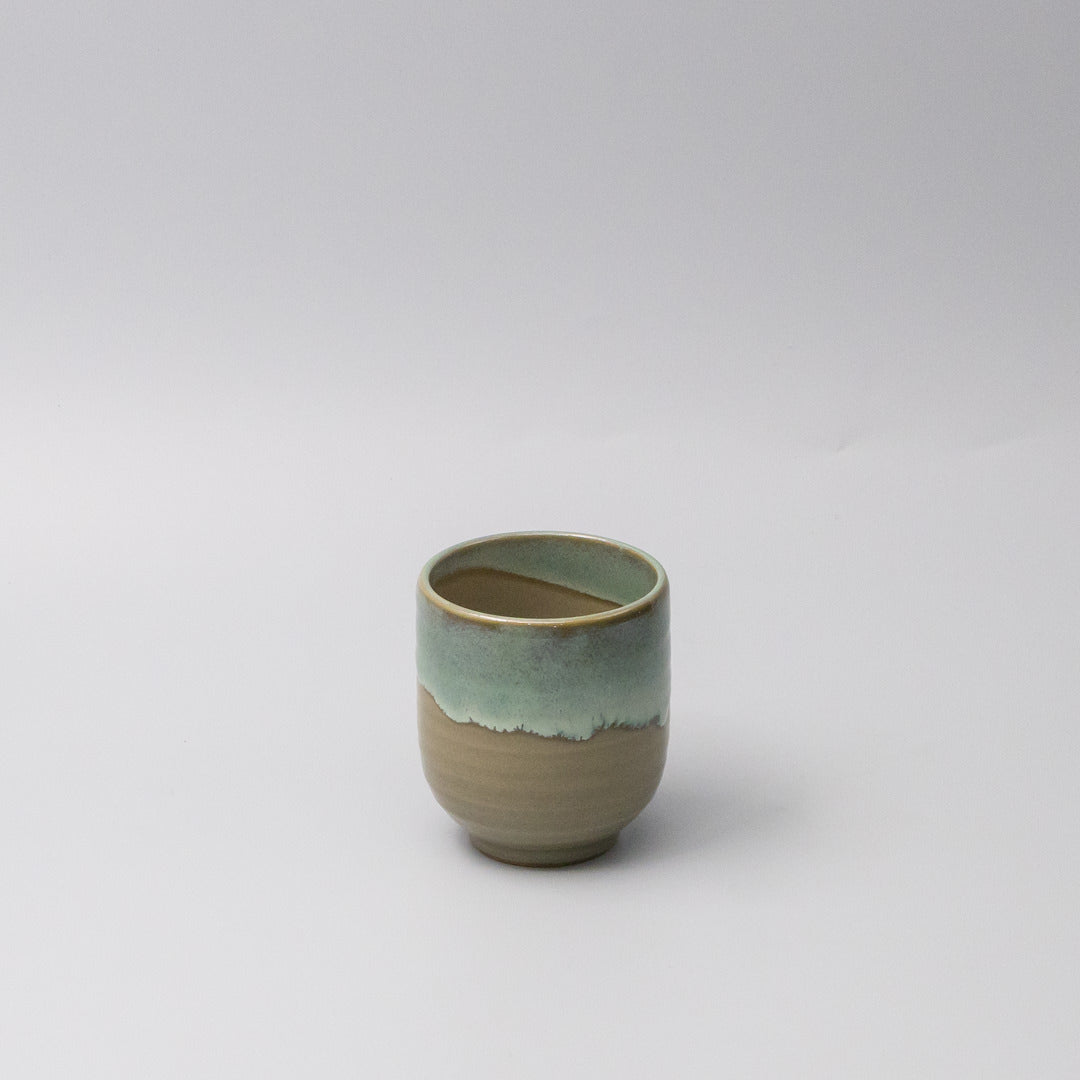
Our Yunomi in Aqua Drip glaze holds 280 ml. Its watery turquoise glaze runs down over a darker body, so each one looks different.

Yunomi, 280 ml, Aqua Drip glaze.

Handle-less cups stack neatly.
Handle-less mugs, and why they work
A handle-less cup sounds impractical until you know how Japanese green tea is made. Most green teas are brewed with water around 70 to 80°C, well below boiling, so the cup is warm in the hand rather than hot. Thick walls slow the heat further. The result is a cup that's pleasant to wrap your hands around on a cold morning, and one that stacks neatly in the cupboard.
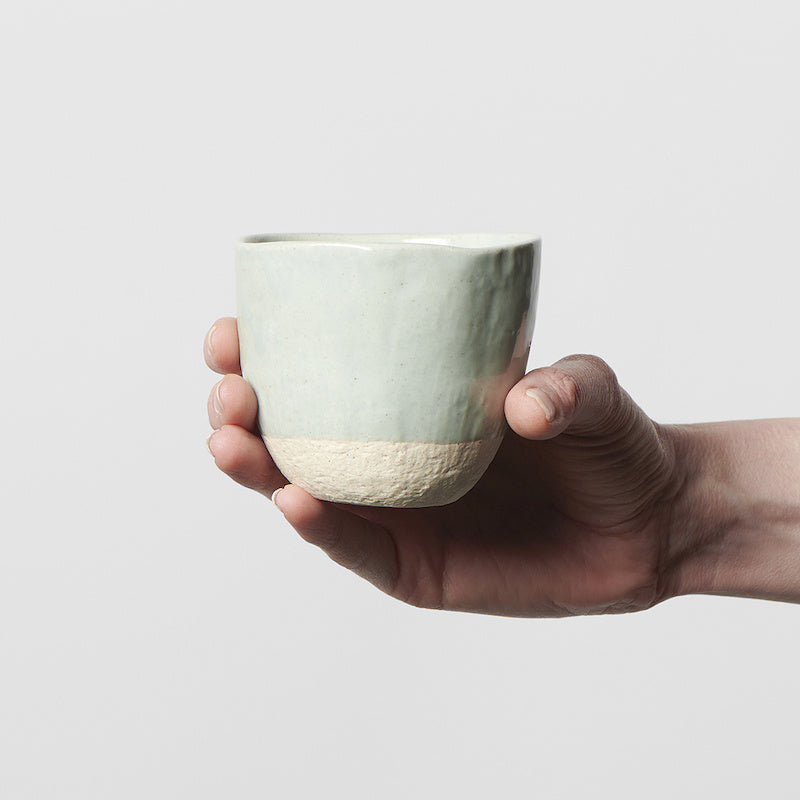
The best-known handle-less mug we sell is the Lopsided Mug, made at the Marunaka family kiln. It's pushed slightly off-round by hand and glazed only part of the way down, leaving the clay showing at the base. It comes in 200 ml and 275 ml in around a dozen glazes. We've written about it in more detail in Lopsided mugs: the wonky tea cup from Gifu.
Other handle-less shapes worth a look are the Taiko mug in Tomei Blue, a short, drum-shaped cup of 265 ml, and the Sky Blue crackle tea mug, a simple 200 ml cup with a fine crackle in the glaze.
Sushi mugs: the cup from the sushi train
If you've eaten at a kaiten-zushi, the conveyor-belt sushi restaurants known in Australia as sushi trains, you'll know the sushi mug. It's a big, heavy, straight-sided cup, often filled with hot powdered green tea from a tap at the counter. The thick walls keep the tea hot through a meal and stop the cup tipping over when people reach across the bench. Traditional versions are printed with the kanji for dozens of fish, which doubles as a quiz for regulars.
The ones we carry hold 250 ml and come in playful prints:
- Food design, covered in drawings of Japanese dishes
- Lucky Symbols, with traditional good-luck motifs
- Panda and Sumo Champions, both good gifts for kids and adults with a sense of humour
They're sturdy enough for everyday use and make a good pen pot on a desk when you're not drinking from them. See them all in Sushi Train Cups.
Mugs with handles
Japan's first coffee house opened in Tokyo in 1888, and kissaten coffee shops have been part of city life ever since, so Japanese potters make plenty of handled mugs too. What sets them apart is the decoration, which often borrows from textiles, ink painting and nature.
- The Wavy Line mug and the Chrysanthemum mug, both 400 ml, are hand painted in indigo on a warm white body, a classic Japanese pairing.
- The small Wave mug holds 200 ml and suits a flat white.
- The Black Drip gift mug comes boxed, which makes it easy to give.
- For something plainer, the Twist mug in Whitewash has a spiral texture you can feel under your fingers.

Taiko mug, Tomei Blue, 265 ml.

Sushi mug, Food design, 250 ml.

Wavy Line mug with handle, 400 ml.
Where they're made
Almost all of these come from Gifu Prefecture, home of Mino ware. The region around Tajimi, Toki and Mizunami has made pottery for more than 1,300 years and today produces around half of Japan's ceramic tableware. That means even an everyday mug is made by people who've worked with the same clay and glazes for generations.
Looking after them
Our Japanese mugs are food safe and, with some care, fine in the microwave and dishwasher. The main risk is thermal shock, so don't move a cup straight from the freezer to boiling water. Hand-glazed pieces vary a little from cup to cup in shape and colour, and that's normal.
Browse all our Japanese mugs and cups, the mugs with handles, or the Lopsided range. For plates and bowls to go with them, read our Made in Japan dinnerware guide.