Most mugs are made to look the same as the one next to it. The Lopsided mug is made to look a little wrong, and that's the point. Each one leans a few millimetres off true, the rim dips on one side, and the glaze stops short of the base so you can see the raw clay underneath. Pick one up and it sits in your palm like a stone from a riverbed rather than a factory cup.
We stock the full range at BEON, in two sizes and a dozen or so glazes. This piece covers where they come from, how they're made, and why a cup without a handle makes more sense than it first appears.

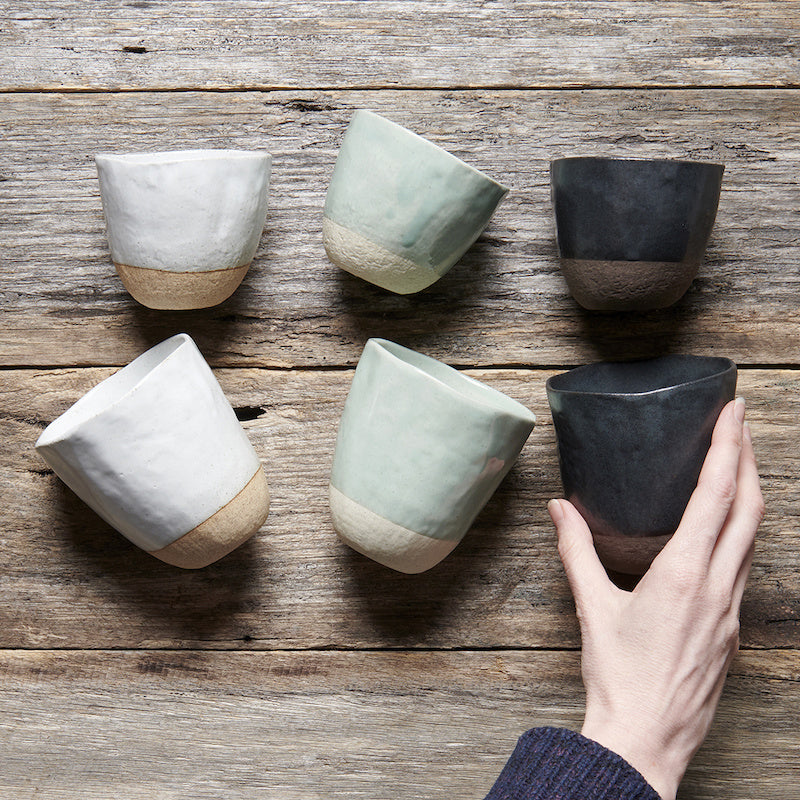
Six glazes, six slightly different shapes.

The bare bisque base shows the colour of the clay.
A family kiln at the end of a narrow road
The mugs are made at the Marunaka family kiln in Gifu Prefecture, in central Japan. Getting there means a run of narrow, winding roads and small bridges over creeks, which tells you something about the scale of the place. Mr Marunaka's father opened the kiln to make one thing: the small lidded cups used for chawanmushi, a savoury steamed egg custard served in Japanese homes and restaurants. That's specialist, repetitive work, and it built the kind of skill with small hand-held vessels that shows in the Lopsided range today.
Over roughly thirty years the kiln has moved beyond custard cups into a wider line of everyday tableware. The Lopsided mug is the piece that has travelled furthest. It's sold well outside Japan now, but it's still made the same way in the same small workshop.
Mino ware, and why Gifu matters
Gifu is the home of Mino ware, or Mino-yaki. Potters have worked the clay around Tajimi, Toki, Mizunami and Kani for more than 1,300 years. In the late sixteenth century, when the tea ceremony was at its height, Mino kilns produced the styles that collectors still chase: the milky Shino glazes, green and black Oribe, and yellow Ki-Seto. Mino ware was recognised as a traditional Japanese craft in 1978, and the region now makes around half of all the ceramic tableware produced in Japan.
That history matters for a simple reason. A small kiln in Gifu has access to good local clay, experienced glaze suppliers and a deep pool of craftspeople. The Lopsided mug looks casual, but it comes out of one of the most serious pottery regions in the world.
How the shape happens
The lean isn't a fault that slipped through. Each mug is formed and then gently pushed out of round while the clay is still soft, so the walls tilt and the rim wanders. The glaze is applied by hand and stopped about a third of the way from the bottom, leaving a band of bare bisque. In the kiln the glaze moves, pools at the lower edge and sometimes runs in small drips. You can't control that exactly, and the kiln doesn't try to.
The Japanese have a word for finding beauty in things that are imperfect, rough and a little worn: wabi-sabi. It gets used loosely, but it fits here. The Lopsided mug isn't distressed to look old. It's simply made by hand and left as it comes.
Why no handle
People sometimes ask whether a handle-less mug is practical. In Japan it's the normal way to drink tea. The everyday tea cup, the yunomi, has no handle, and you hold it with both hands or with your fingers around the upper part of the cup. Green tea is usually brewed below boiling, around 70 to 80°C, so the cup is warm rather than painful to hold.
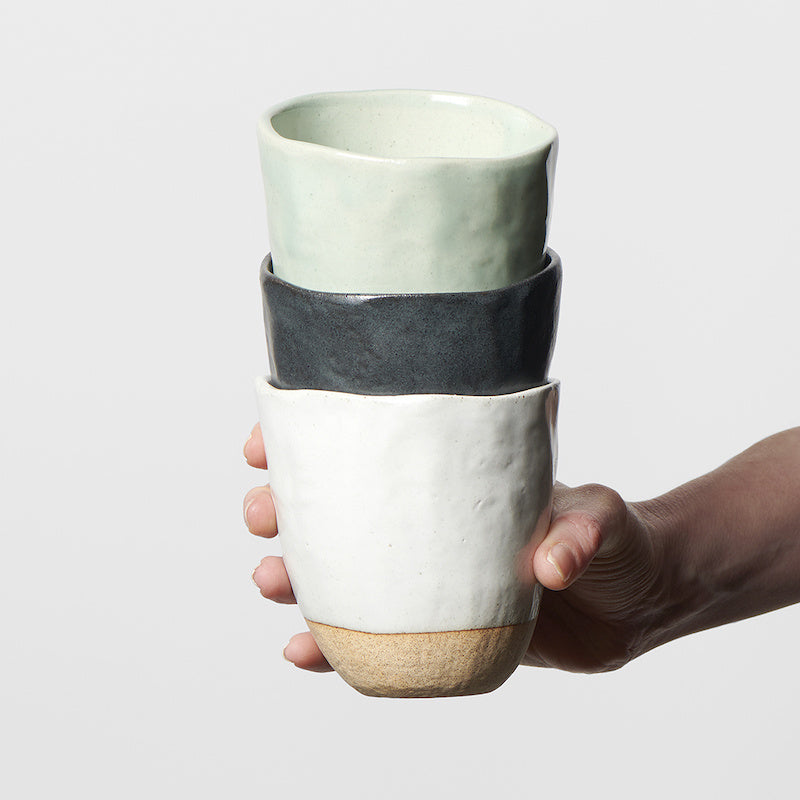
The Lopsided mug works the same way. The walls are thick enough to soften the heat, and the uneven shape gives your fingers somewhere natural to rest. For a very hot black coffee you might want to let it sit for a minute. For tea, matcha latte, hojicha or a flat white, it's comfortable straight away. Without a handle it also stacks, which is handy in a small kitchen.

Held the Japanese way, fingers near the rim.

White & Bisque, the quietest glaze in the range.

No handle, so they stack.
Two sizes
- 200 ml: about 8 cm across and 7 cm tall. Good for green tea, espresso drinks, a short macchiato or a small hot chocolate for a child.
- 275 ml: about 9.3 cm across and 9.5 cm tall. The everyday size for a cup of tea, a latte or a smoothie.
The capacities are measured to the brim, so a comfortable pour is a bit less. If you mostly drink milky coffee, go for the 275 ml. For more on choosing between them and on every glaze we carry, see our Lopsided glaze and size guide.
Care
Lopsided mugs are food safe and can go in the microwave and dishwasher. The thing to avoid is sudden temperature change. Don't take one from the freezer and fill it with boiling water, and put a very hot mug down on wood or cloth rather than cold stone. Hand washing will keep the glaze bright for longer, and the bare base can be wiped dry so it doesn't stay damp in the cupboard.
A good gift, and a good set
Because each mug is different, they make an easy gift. A pair in two glazes says more than a matching set, and at under $20 each they don't need a special occasion. If you're building a set for home, pick two or three glazes from the same colour family and buy one more than you think you need. Someone always ends up with a favourite.
See every glaze and size on the Lopsided Mug page, or browse the wider Japanese mugs and cups collection. For more on the different kinds of Japanese cup, read our guide to yunomi, sushi mugs and handled mugs.